LED transparent screens usually cost from $500 to $2,500 for each square meter. The price changes based on the type you pick. Film screens often cost between $600 and $1,500 per square meter. Mesh screens can cost as much as $2,400 per square meter. The table below shows how LED transparent screens change by pixel pitch and price:
Sphere LED Display Pixel Pitch | Cost per Square Meter (USD) | Use Case / Notes |
|---|---|---|
P1.5 | Around $3,000 | High resolution, luxury retail |
P2.5 | Up to $500 | Corporate, education |
P3 / P4 | $1,000 - $1,500 | Large venues, events |
The main things that change the cost are pixel pitch, transparency rate, brightness, and installation size. Prices can be very different, sometimes up to 300% more, based on brand, features, and certifications. The chart below shows how these things can change the final price for transparent led screens:
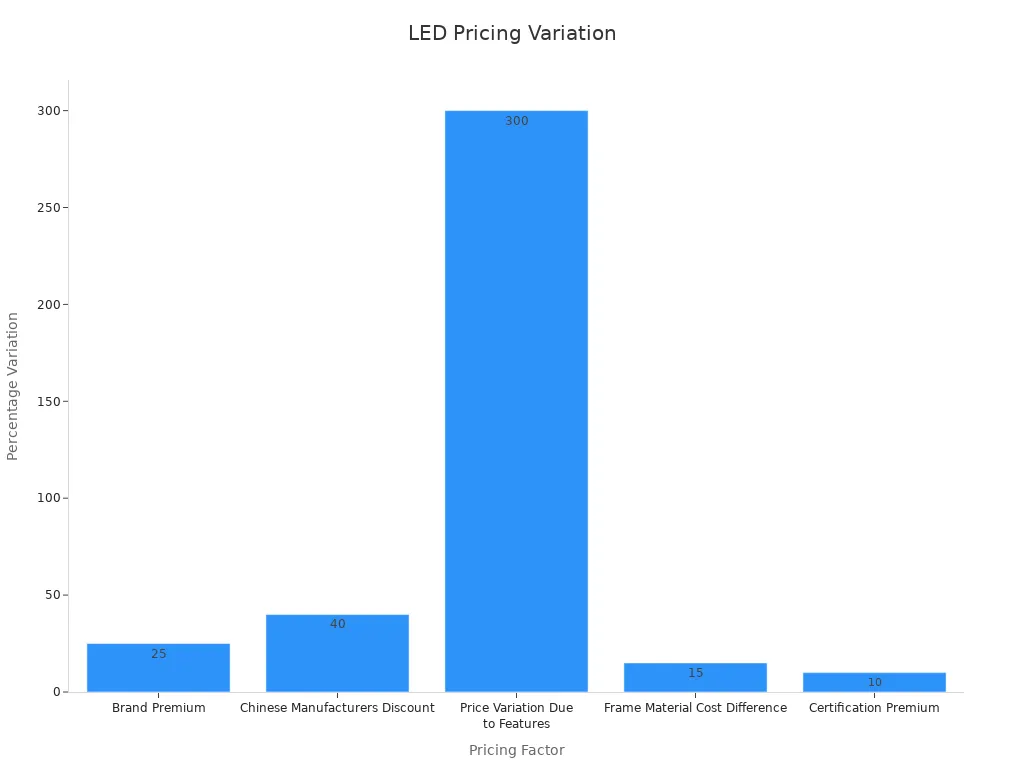
Knowing what affects the cost helps buyers plan their budget for transparent led screens and pick the best display for what they need.
LED transparent screens cost from $500 to $2,500 for each square meter. The price changes based on type, pixel pitch, and features. - The main things that change the cost are pixel pitch, transparency rate, brightness, screen size, how hard it is to install, and if you want special changes. - There are different kinds of screens like film, mesh, and front-emitting. They are used for many things, like store windows or big outdoor signs. - Picking the right screen means you need to think about what you need and how much you can spend. You should focus on what works best for your project. - If you ask suppliers clear questions and plan well, you can save money. This also helps make sure your LED transparent screen works well.
The price of transparent led screens can be very different. It depends on the type, pixel pitch, and how you use them. Most regular led transparent screens cost from $500 to $2,500 for each square meter. Film screens usually cost between $600 and $1,500 per square meter. Mesh screens are more flexible and often cost $2,300 to $2,400 per square meter. Some cheaper options cost $180 to $280 for each piece or square meter. These cheaper screens may not last long or have special features.
The table below shows the newest prices for different transparent led screens and what they are used for:
Screen Type | Pixel Pitch (mm) | Price Range (USD per m²) | Typical Applications |
|---|---|---|---|
Indoor transparent LED display | $1,200 - $2,200 | High-end commercial, luxury stores, museums | |
Indoor transparent LED display | P2.8 - 5.6 | $950 - $1,900 | Medium-sized enterprises, exhibition centers |
Indoor transparent LED display | P3.9 - 7.8 | $800 - $1,200 | General indoor commercial displays |
Outdoor transparent LED display | P3.9 - 7.8 | $1,000 - $1,300 | Urban lighting, billboards, sports venues |
Outdoor transparent LED display | P5.2 - 10.4 | $900 - $1,200 | Large billboards, long-distance viewing |
Note: Indoor transparent led mesh screens can cost as little as $250 to $450 per square meter. If you want a 6x3 meter screen, the total price with the control system and packaging is $5,000 to $9,000.
The price range for transparent led screens shows there are many choices. The design, resolution, and how you set them up all matter. Buyers should look at the details and how they will use the screen before buying.
There are a few main things that change the price of led transparent screens. Knowing these things helps buyers plan their money and pick the right screen.
Pixel Pitch: A smaller pixel pitch means the screen looks clearer. For example, a P1.2 screen uses about 68,000 led beads for each square meter. This can be up to 40% of the total price. Making high-density screens like P1.2 can cost $25,000 to $35,000 for each square meter. Regular P3 screens are much cheaper.
Transparency Rate: A higher transparency rate lets more light go through the screen. This makes the screen harder to see when it is off. Screens with high transparency need better materials and design, so they cost more.
Brightness: Brighter screens use more power and need better parts. For example, a P1.2 screen at full power uses about 400 watts for each square meter. If you add energy-saving tech, the first price goes up by about 15%. But this can save 20% on running costs later.
Size and Installation: Bigger screens and tricky setups cost more for materials and work. Special shapes or curved screens also make the price go up.
Processor and Control System: Screens with high resolution and 4K need better processors. These can cost over $10,000 each. Normal processors for regular screens are much cheaper.
Customization: If you want special shapes, waterproofing, or to fit the screen into a building, the price will be higher.
The price of led transparent screens depends on how these things work together. For example, a big outdoor screen with high brightness and a fine pixel pitch will cost a lot more than a small indoor screen with basic features.
Tip: Buyers can save money by picking a pixel pitch and brightness that fits what they really need. They do not have to choose the highest specs every time.
 Image Source: pexels
A transparent led display lets you see through the screen. It uses special led technology. You can see digital images and what is behind the screen. These screens let sunlight come in. They work well in store windows and glass walls.
Some important features are:
High transparency rates, sometimes up to 90%. This means you can still see what is behind the screen.
They save energy. The screens use led lights and can change brightness by themselves. This helps use less power and keeps your eyes from hurting.
Some screens are light and bendy. Thin film screens and flexible grid screens can fit on curved or odd shapes.
The screens have a modular design. This makes them easier to put together and fix, even for big or special projects.
Technical Characteristics & Features | Typical Applications & Market Use Cases | |
|---|---|---|
Hard Light Bar Transparent Screen | Transparency about 60-80%, uses old technology, hollow design lets you see through | Used for digital stage art, popular in the market |
Flexible Grid Screen | Can connect modules, size can change, pixel pitch P25~P200mm | Used in real estate, malls, glass walls, and hotels |
LED Grille Screen | Has big spaces, two types: in-line and surface mount lamp beads | Used outside on buildings and for lighting |
Flexible LED Film Screen | Very thin and light, can bend to fit curves | Used in malls, atriums, elevators, and glass fences |
Photoelectric Glass Screen | Mixes glass and led, up to 90% see-through, very bright | Used for building walls, windows, and museums |
Thin Film Screen | Looks like clear crystal, soft and thin, uses special films | Used inside for fences and glass dividers |
These features help more people use transparent led displays. They are used in city ads, stores, and building designs.
Transparent led screens are different from regular led screens. Regular led screens are not see-through. They block what is behind them. Transparent led screens let you see both the digital images and what is behind the screen.
Advantage Category | Transparent LED Screens | Traditional LED Displays |
|---|---|---|
Visibility | Lets up to 90% of light through; you can see behind | Not see-through; blocks what is behind |
Engagement Metrics | Can bring up to 19% more people to stores | No extra people from being see-through |
Content Flexibility | Can update content fast, supports QR codes, NFC, AR | Not as flexible, less interactive |
Aesthetic Integration | Keeps the look of the store, can be changed | Can block the store view |
Maintenance & Durability | Easy to take care of, uses less energy, modular | Focuses on saving energy, but not see-through |
One study showed stores with transparent led screens got up to 19% more visitors. These screens can show new content right away and let people use QR codes or NFC. Transparent led screens mix new digital ideas with real places. That is why they are popular in new stores and buildings.
Pixel pitch is the space between each LED on the screen. Smaller pixel pitch means LEDs are closer together. This makes the picture look sharper and clearer. Screens with fine pixel pitch cost more money. They use more LEDs and better technology. For example, a 3.9mm pixel pitch screen has high resolution. It costs more than a 10.4mm screen. Buyers should pick pixel pitch based on how close people will view the screen. Finer pixel pitch is best for places like stores or museums.
Transparency rate tells how much light goes through the screen. Higher transparency means you can see through the screen better. When the screen is off, it is less visible. More natural light can come into the room. Screens with over 80% transparency use special materials. This makes them cost more. For example, a 90% transparency screen costs more than a 60% one. Buyers need to think about how much see-through effect they want. They should also think about how bright and clear the display needs to be.
Brightness shows how well the screen can be seen in different light. Brighter screens use better LEDs and need good cooling. This makes them cost more. The table below shows how brightness, pixel pitch, and transparency rate change the price:
Pixel Pitch | Transparency Rate | Brightness Range (nits) | Approximate Price Range (USD/m²) |
|---|---|---|---|
3.9mm | 60% – 70% | 4,500 – 6,000 | $2,600 – $4,200 |
5.2mm | 65% – 75% | 4,500 – 6,500 | $2,300 – $3,800 |
6.2mm | 70% – 80% | 4,000 – 6,000 | $1,900 – $3,200 |
10.4mm | 80% – 90% | 4,500 – 7,000 | $1,600 – $3,000 |
Some screens have very high brightness, like holographic invisible transparent screens. These can reach up to 5,000 nits. They cost between $2,800 and $4,800 for each square meter.
The size of the screen changes the total price a lot. Bigger screens need more parts and more work to set up. If the screen is curved or has a special shape, it costs even more. The tables below show how size and type affect the cost:
Installation Size Category | Approximate Size | Cost Range |
|---|---|---|
Small LED Billboards | 20-30 square meters (approx. 215-323 sq ft) | $5,000 to $15,000 |
Medium LED Billboards | 100-300 square feet | $15,000 to $50,000 |
Large LED Billboards | Above 300 square feet | $50,000 to several hundred thousand dollars |
Billboard Type | Size (feet) | Cost Range |
|---|---|---|
Small Billboard | 10×20 | $10,000 to $50,000 |
Large Billboard | 20×40 or larger | $50,000 to $200,000 |
Prime Location Large Screens | N/A | Starting at $200,000 |
Note: Putting up the screen and making it work can add a lot to the final price. This is true for big or tricky projects.
Customization means making the screen special for your needs. This can be a special shape, waterproofing, or a unique way to hang it. Custom screens need extra design and planning. This makes them cost more. For example, a screen for a curved glass wall costs more than a flat one. Custom features help the screen fit your project. But they always make the price go up.
In summary, higher transparency, smaller pixel pitch, more brightness, bigger size, and custom features all make transparent LED screens cost more. Buyers should think about these things to get the best deal for their project.
 Image Source: pexels
Film screens are thin and bendy. They stick right onto glass. These screens let lots of light through. They are not heavy. Stores and malls use film screens in windows. This makes displays look cool but does not block sunlight. The price changes by pixel pitch and model. A P10 model costs $800 to $1,200 for each square meter. A P5 model can cost up to $2,500 per square meter. Most film screens cost between $500 and $3,000 per square meter.
Model (Pixel Pitch) | Price Range (USD per sqm) |
|---|---|
P5 (5mm) | $1,300 – $2,500 |
P6.25 (6.25mm) | $1,200 – $1,800 |
P8 (8mm) | $1,000 – $1,500 |
P10 (10mm) | $800 – $1,200 |
P15 (15mm) | $600 – $900 |
P20 (20mm) | $500 – $800 |
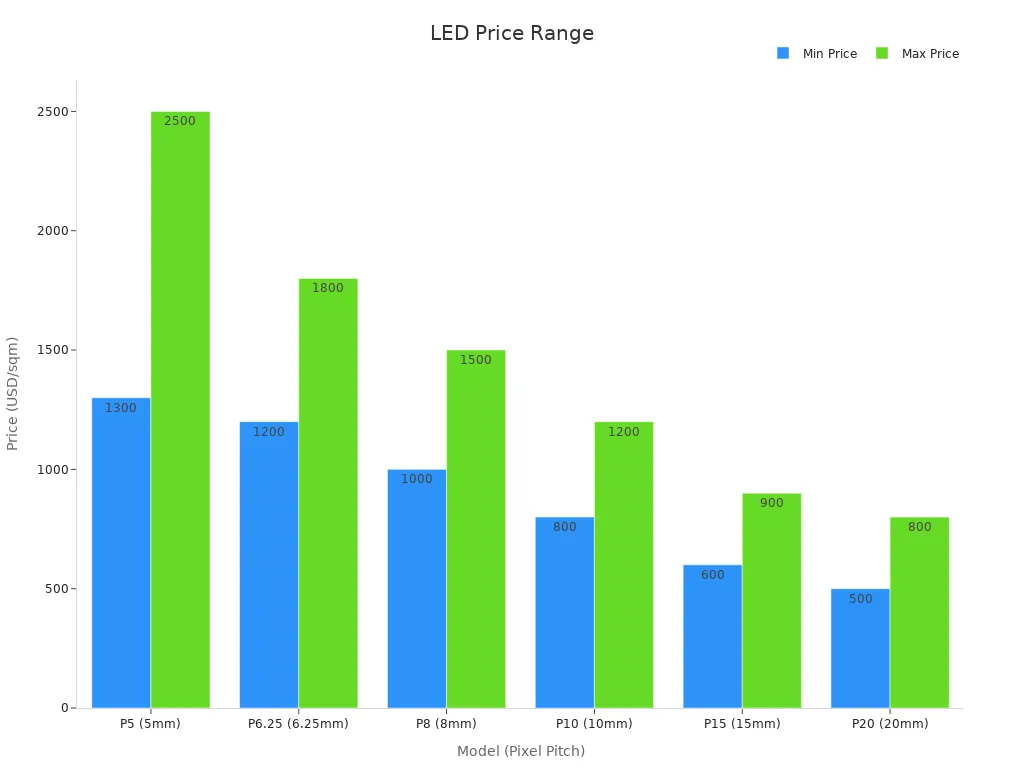
Film screens are best for stores, showrooms, and glass walls. They are light and almost invisible.
Mesh screens look like a grid. Air and light can go through them. These screens are good for big outdoor places. People use mesh screens on buildings, stages, and sports fields. Mesh screens usually cost $2,300 to $2,400 for each square meter. They are strong and can handle wind and rain. That is why they work well for ads outside and lighting on buildings.
Mesh screens let lots of light through and last a long time.
They are great for big displays where weight and wind matter.
Front-emitting screens use new led tech. They show pictures right to people watching. These screens are bright and have great colors. Many companies use them for special projects. You can see them in museums, fancy stores, and cool exhibits. The price for front-emitting screens starts at $1,000. It can go up to $2,500 for each square meter. The price depends on how clear and big the screen is.
Front-emitting screens give the best pictures. They are used when you want the display to really stand out.
Screen Type | Typical Price Range (USD/m²) | Best Applications |
|---|---|---|
Film | $500 – $3,000 | Retail, glass walls, showrooms |
Mesh/Curtain | $2,300 – $2,400 | Outdoor, building facades, large venues |
Front-Emitting | $1,000 – $2,500 | Museums, luxury retail, custom projects |
Stores use transparent led screens to make their windows stand out. These screens let sunlight in and show moving pictures at the same time. Transparent adhesive led films start at about $1,290 for each square meter. Covering a whole window can cost from $5,000 to $50,000. The price depends on how big the screen is and the pixel pitch. Many stores pay as much for setup as for the screen itself. For example, a fancy shop in Shanghai used a 70% transmittance display. This helped bring in more shoppers and saved energy. Content management systems add about 20–25% to the total price. Lighter screens are easier to put up and cost less for support. That is why modern stores like them.
Big transparent led screens are used in airports, malls, and office buildings. These projects need careful planning and special frames. Large screens usually cost from $50,000 to over $200,000. Fancy projects, like the Shenzhen Airport’s 82% transmittance display, cost more because of special features and size. The market for transparent led screens is getting bigger. Big companies spend money on research to make better screens. Harder projects with small pixel pitch and building system links cost more for both parts and setup.
Outdoor transparent led screens must handle rain and be very bright. Most outdoor screens cost between $500 and $1,500 per square meter. A screen that is 15–20 square meters costs $15,000 to $50,000. Very big billboards can cost more than $150,000. Putting up outdoor screens needs experts and strong frames. This adds $5,000 to $10,000 or even more. Each year, fixing and caring for the screen costs 5–10% of its value. New outdoor screens can change brightness and use solar power. This can cut energy use by up to 35%.
Custom transparent led screens are made for special shapes and uses. These include curved tunnels, event walls, and cool building designs. Prices can be very different. Small indoor screens can cost $5,000. Big, tricky projects can cost over $1,000,000. For example, a 4m x 2.5m event wall costs $8,000 for the screen and $2,000 for setup. Hard things like lining up seams and seeing the screen in daylight can make it cost more. Fancy projects need better control systems and special ways to hang the screen. This makes planning and care harder.
The size of the project, special features, and how hard it is to set up all change the final price of transparent led screens. Good planning and checking the site help keep costs down and make sure the project works well.
To have a good project, you must know what you need. When picking a transparent led screen, teams should set clear rules. These rules can be:
The exact size of the screen
What the screen must do, like how bright it is or if you can touch it
How it should look, such as matching glass or metal
Safety and comfort rules
Goals for being green and saving energy
How much money you can spend
What users and the market want
What materials and parts to use
Steps to check quality
Giving clear details makes sure the led screen works for your project. For example, saying you want 70% transparency for a glass wall gives a modern style and meets design needs. Teams should not use unclear or too many strict rules.
Looking at cost is more than just the price. Teams need to match features with the budget. The table below shows how regular and transparent led screens are different:
Feature | Traditional LED Screen | LED Transparent Screen |
|---|---|---|
Transparency | Opaque | 60%-95% see-through |
Brightness | Higher | Lower, but adjustable |
Aesthetics | Visible borders | Minimal, blends with background |
Installation | More structural work | Easier, less impact on building |
Maintenance | Complex | Easier, modular |
Cost | Stable, mature tech | Higher initial investment |
A fancy store might pick a transparent led screen for its window. The first cost is higher, but it brings in more shoppers and helps sales. Teams should think about space, what will be shown, and how much money it will make over time.
Smart buyers ask suppliers good questions before buying. Some important things to ask are:
What is the total price, including setup and help?
How does the supplier make sure the screen is good and works well?
How long will the screen last and what is the warranty?
Can the supplier show past jobs or happy customers?
How do they handle problems or delays?
What tools or software do they use to track orders?
How do they manage contracts and follow rules?
These questions help buyers pick good partners and avoid problems.
Teams can save money and still get good screens by doing these things:
Pick the right pixel pitch for how far people will be
Only choose the features you really need
Use normal sizes to keep costs down
Plan the setup early to stop extra work costs
Get prices from different suppliers
Ask about ways to save energy and lower bills later
Tip: Picking screen features that fit your real needs stops you from spending too much and makes sure the led transparent screen is worth it.
Transparent LED screens cost more at first than regular signs. But they save money on repairs and power later. The table below shows how the costs are different:
Cost Aspect | Traditional Signage | Transparent LED Screen |
|---|---|---|
Initial Investment | ¥2.1M | ¥5.8M |
Annual Maintenance | ¥387K | ¥156K |
Energy Costs | ¥84K | ¥31K |
Annual Ad Revenue | ¥0 | ¥6.2M |
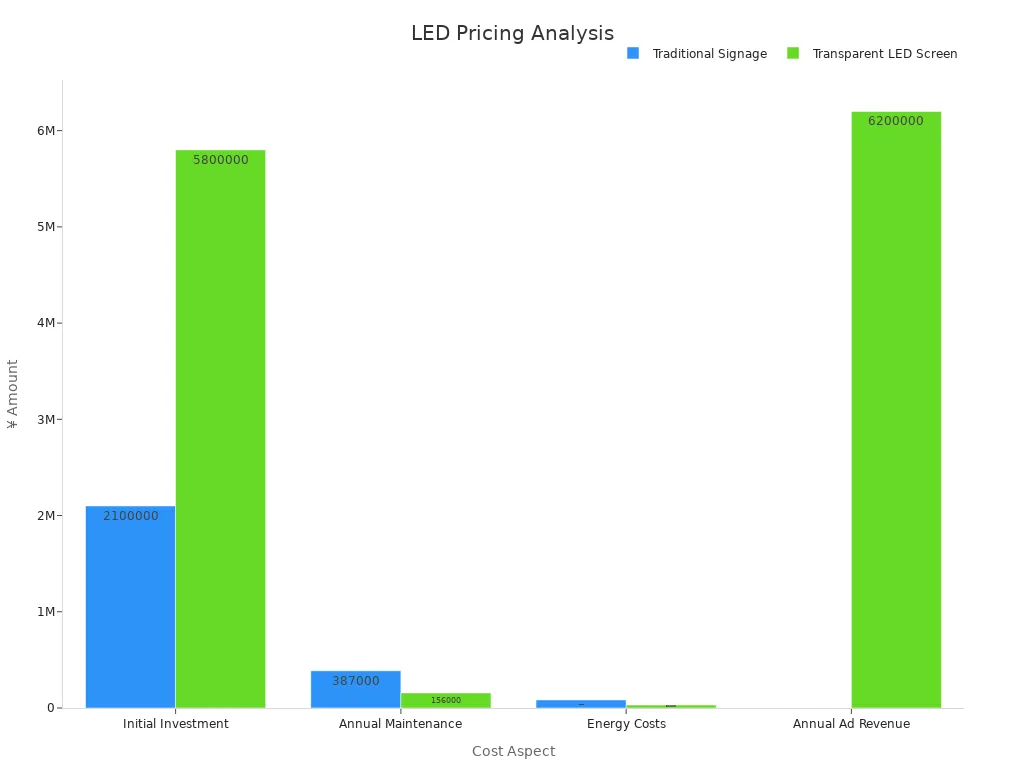
Project teams should look at all choices and set clear plans. They need to ask for full price lists from suppliers. Talking to suppliers helps pick what works best for the money and future needs.
Most LED transparent screens work for 50,000 to 100,000 hours. Taking care of them and cleaning them often helps them last longer. Many companies give a warranty for 2 to 5 years.
Yes, some models can be used outside. Outdoor screens are made with strong, weatherproof materials. They are also brighter than indoor screens. Always look at the IP rating and ask the seller if the screen is good for outdoor use.
Transparent LED screens use less energy than regular displays. Their design lets sunlight come in, so you do not need as many lights. Some screens have energy-saving features that help lower costs even more.
You should dust and clean the screens gently to keep them clear. Technicians need to check the connections and update the software. Most screens have parts that are easy to replace, so fixing them does not take long.
Most screens use special software or a control system. You can add videos, pictures, or words from a computer or phone. Some systems let you change what is on the screen from far away and set times for updates.